Deploy clinical infrastructure that measures before it reasons.
For ministries of health, hospital networks, insurers and industrial operators. ZoyeMed fleets extend clinical reach into places without physicians; Zoyel SSM turns the fleet's measured data into population intelligence; Zoyel.one runs the organisation around it.
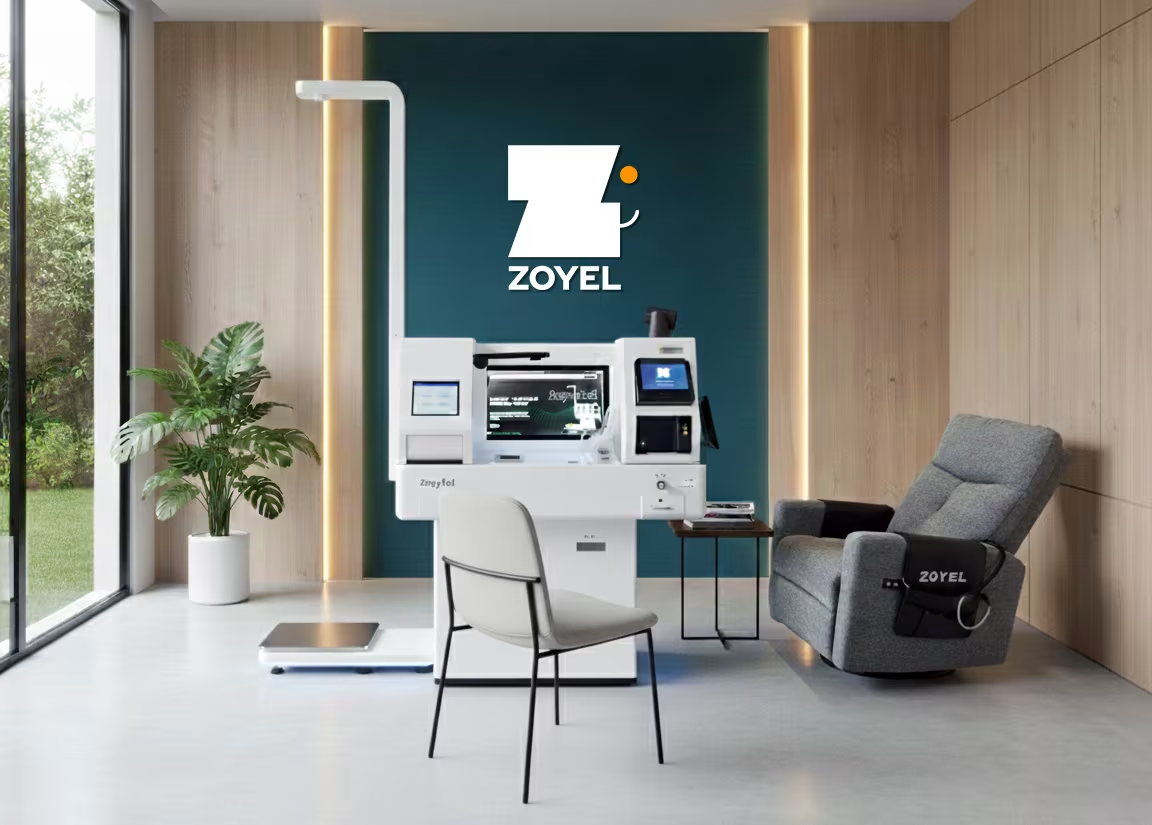
Who deploys ZoyeMed, and for what
Ministries of health and public programmes
Clinical-grade encounters in geographies without physicians, run by trained operators under remote specialist supervision. Each terminal is also a population health sensor: measured, anonymised data aggregates into disease incidence, nutrition and outbreak signals through Zoyel SSM. Data residency is a property of the architecture, with identifiers anonymised on the device.
Hospital networks and health systems
Diagnostic depth at spoke sites while central clinicians keep authority and audit. FHIR R4 output with ICD-10/11, SNOMED CT, LOINC and RxNorm coding into existing HIS and EMR systems. Specialists review structured, measured encounters rather than conduct them.
Insurers and payers
Sensor-acquired data at the point of encounter in place of self-reported declarations. Longitudinal trajectories surface drift toward chronic conditions before threshold diagnosis. Sensor-anchored, cryptographically audited clinical events cannot be fabricated after the fact.
Industrial and occupational health
On-site encounters for mines, factories, oilfields and large campuses without evacuating the worker. Periodic comprehensive health encounters build a longitudinal cohort record; respiratory shifts and biomarker clusters are detected across the workforce.
How a deployment is sized
ZoyeMed is institutional infrastructure. Three demonstration sets are available for evaluation. Programmes start at 25 units; the clients we serve best run 100+ units across a network, where standardised quality and population intelligence pay for themselves.
From signed agreement to first encounters is typically 90 to 120 days: logistics and customs, site preparation and HIS integration, operator certification, then a supervised go-live with post-market surveillance from day one.
- Briefing and evidence review. Public white paper, PMCF summary, technical white paper on verified corporate email; full PMCF report and financial model under NDA.
- Configuration. Choose among ZoyeMed 1.0, 2.0, 3.0 Connected, 3.0 Edge AI and 3.0 Resilience Edition by test menu, connectivity and where inference should run.
- Jurisdiction bundle. Data residency, consent scope, protocol routing and operator credentialing are configured at the governance layer; the codebase is never forked.
- Operator training. Certification programme for the healthcare workers who run each terminal, with remote specialist supervision in place before go-live.
- Go-live and surveillance. Supervised period, immutable audit trail, and post-market clinical experience reporting against your regulator's expectations.
Zoyel SSM
State-space-model health intelligence that synthesises your data with data generated by ZoyeMed and Virtual Clinics. National, provider and payer lines. Ready, and built out per client.
Zoyel SSMZoyel.one
The sector-agnostic business suite under every deployment: HR, finance, CRM, documents, meetings and compliance. Available on its own to any organisation.
Zoyel.oneZoyel HIS
An AI-powered hospital information system, largely built and in development until beta completes, designed as a modern, standards-based alternative to legacy HIS platforms.
RoadmapCommon evaluation questions
Is ZoyeMed a health kiosk?
No, although buyers usually meet it on the same shortlist. A health kiosk or health ATM captures a handful of vitals and routes to a video doctor. ZoyeMed completes the primary-care episode: 120+ modalities including biochemistry, haematology and immunoassay, 12-lead ECG and imaging, on-device AI and mandatory clinician sign-off. Full comparison.
What is the regulatory position?
The terminal is general-purpose clinical IT infrastructure, CE Electrical and NYCE Mexico certified, deployed with separately certified medical device and IVD modules. Zoyel.Health, the decision-support software, is licensed as Class B Software as a Medical Device under India's CDSCO framework. CE-MDR assessment of the integrated configuration, COFEPRIS and INVIMA are in process. Status is confirmed market by market before any deployment.
Does it work without internet?
The Resilience Edition runs the complete clinical episode, including AI inference, with no connection at any stage, and syncs de-identified metadata when a link appears. Resilience Edition.
Where is pricing?
Pricing, the financial model and territory terms are shared after a briefing call and NDA. Nothing on this site is an offer.