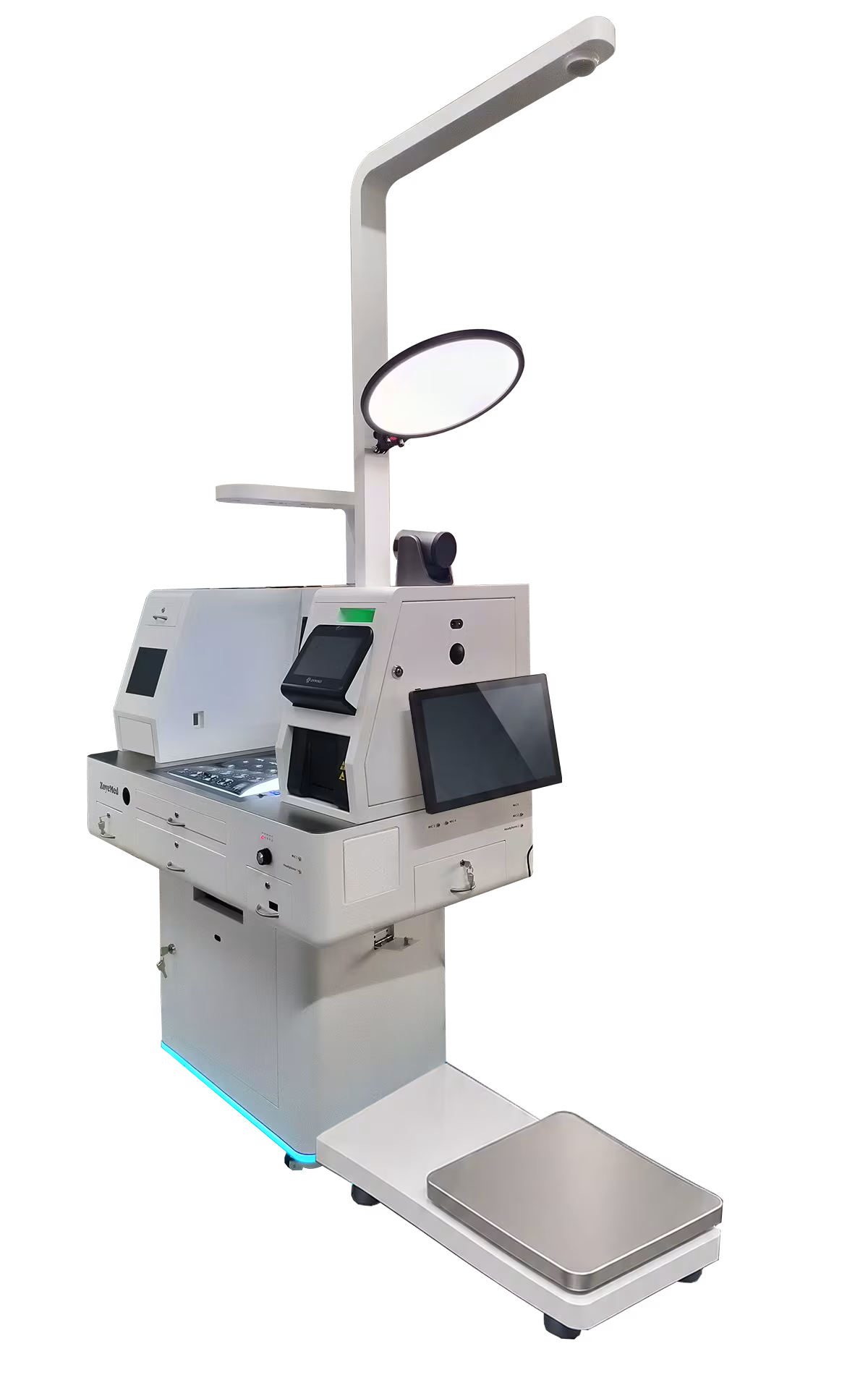
A fully standalone clinical AI terminal engineered to deliver a complete medical episode - triage, examination, diagnostics, and prescription support - without an internet connection at any stage.
It isn't always. Continuity of care is among the first casualties of infrastructure disruption - natural disasters, grid instability, remote and last-mile settings, and network outages routinely sever the connectivity that cloud-dependent systems require.
That failure tends to arrive at the worst possible moment: precisely when clinical capacity is needed most, and hardest to reach.
The Resilience Edition removes the cloud from the critical path of care - not as a feature, but as the architecture.
Replaces the capital and recurring cost of multiple outpatient rooms, labs, and diagnostic suites with a single 5 square-metre unit.
Triage, examination, diagnostics, and prescription support in one visit - instead of weeks of referrals across separate sites.
Every terminal delivers the same protocolised, AI-supported standard of care, regardless of who is operating it.
The complete AI runs on the device. A terminal can operate indefinitely without ever establishing a network connection.
Structured records and an immutable audit trail give operators verifiable visibility into clinical activity and utilisation.
Patient data stays where it was generated. Only de-identified metadata is synchronised, and only when connectivity allows.
The Resilience Edition retains the full clinical feature set of ZoyeMed 3.0, with an integrated overhead examination light and power conditioning for operation on unstable grids.
Biochemistry, haematology, and immunoassay panels - liver and renal function, lipids, electrolytes, cardiac enzymes, diabetes and inflammatory markers.
12-lead digital ECG, digital stethoscopy, spirometry, dermatoscope, oto/rhinoscope, fetal Doppler, and thermal imaging.
A multi-spectral imaging suite for AI analysis and remote clinical collaboration.
The Zoyel model analyses the trajectory of a patient's vitals and investigations over time, not a single snapshot.
Hash-chained, append-only records of every clinical action - verifiable traceability, even offline.
Operates across eight languages, configurable to the deployment context.
A physician operates the terminal directly for full-spectrum primary and acute care.
A trained nurse conducts the visit, with a clinician providing sign-off on diagnosis and advice - on-site or remotely.
Structured self-service screening where staffing is constrained, with clinician review built into the workflow.
ZoyeMed 3.0 is a clinical decision-support system. Final diagnostic and prescribing decisions remain under the authority of a licensed clinician in every operational mode.
The system is designed to extend the reach of clinicians into the environments they could not otherwise serve - and to equip frontline staff with structured, auditable support at the point of care.
The terminal's value doesn't depend on a doctor being physically present ‐ that's the point. ZoyeMed 3.0 is designed around the reality that clinical staffing varies enormously by setting, and it operates in three modes so that it remains useful across that whole range, not just the best-case scenario.
A licensed clinician holds final authority over every clinical decision in every mode. What changes is who is in the room and how they are connected.
Everything clinical. In the Resilience Edition, triage, examination, 120+ point-of-care tests, decision support, and prescription support all execute locally on the device. A terminal can operate indefinitely without ever establishing a network connection.
When connectivity becomes available, only essential de-identified metadata is synchronised ‐ clinical operation does not depend on it.
Doctor on-site: the terminal amplifies the clinician, extending a generalist's reach toward specialist-level breadth in a single visit.
Nurse-operated: a large share of primary-care contacts ‐ health screening, routine check-ups with lab work, monitoring of stable chronic conditions, and triage-to-referral ‐ can be completed within protocol by a trained nurse. The system flags anything that falls outside protocol and routes it to a clinician.
Remote clinician: where no clinician is on-site, the terminal captures a complete, structured clinical picture so a clinician connected by phone or data link can review and sign off quickly. The AI assembles the evidence; a licensed human makes the call.
The system is engineered to suppress output when input data is insufficient or unreliable, rather than generating a confident answer from incomplete information. It is designed to say “not enough information” instead of guessing ‐ the opposite of how a general-purpose chatbot behaves.
This reliability-gating is core to how it operates in exactly the low-resource conditions where errors would be most consequential.
In disaster response or infrastructure collapse, the terminal continues to provide structured guidance to whoever is present. It does not replace a clinician and it does not make autonomous clinical decisions ‐ it provides structured information and decision support to a human operator.
The appropriate standard of care is contextual: what is achievable in a field setting under infrastructure failure differs from a fully resourced hospital. Responsible deployment recognises that difference while keeping a human accountable for every action.
No. ZoyeMed 3.0 is a human-in-the-loop clinical decision-support system. It is designed to extend the reach of clinical teams into environments they could not otherwise serve, and to equip frontline staff with structured, auditable support at the point of care. Final diagnostic and prescribing decisions remain with a licensed clinician in every mode.
Every operational mode keeps final clinical authority with a licensed human. Every action is recorded in an immutable audit trail ‐ hash-chained, append-only records of each clinical action ‐ providing verifiable traceability even in disconnected environments. The system operates within protocol constraints, with escalation gates that require human authorisation for defined actions.
Clinical components are CE-compliant; integrated-system regulatory status varies by jurisdiction, and deployment in any market follows that market's regulatory framework. For specific regulatory questions in your market, please contact our team.
Speak with our team about deploying the ZoyeMed 3.0 Resilience Edition across your network, region, or programme.
ZoyeMed 3.0 is a human-in-the-loop clinical decision-support system intended for use under the authority of a licensed clinician. It does not replace professional medical judgement. Clinical capabilities and regulatory status vary by jurisdiction; contact Zoya Technologies for details applicable to your market.